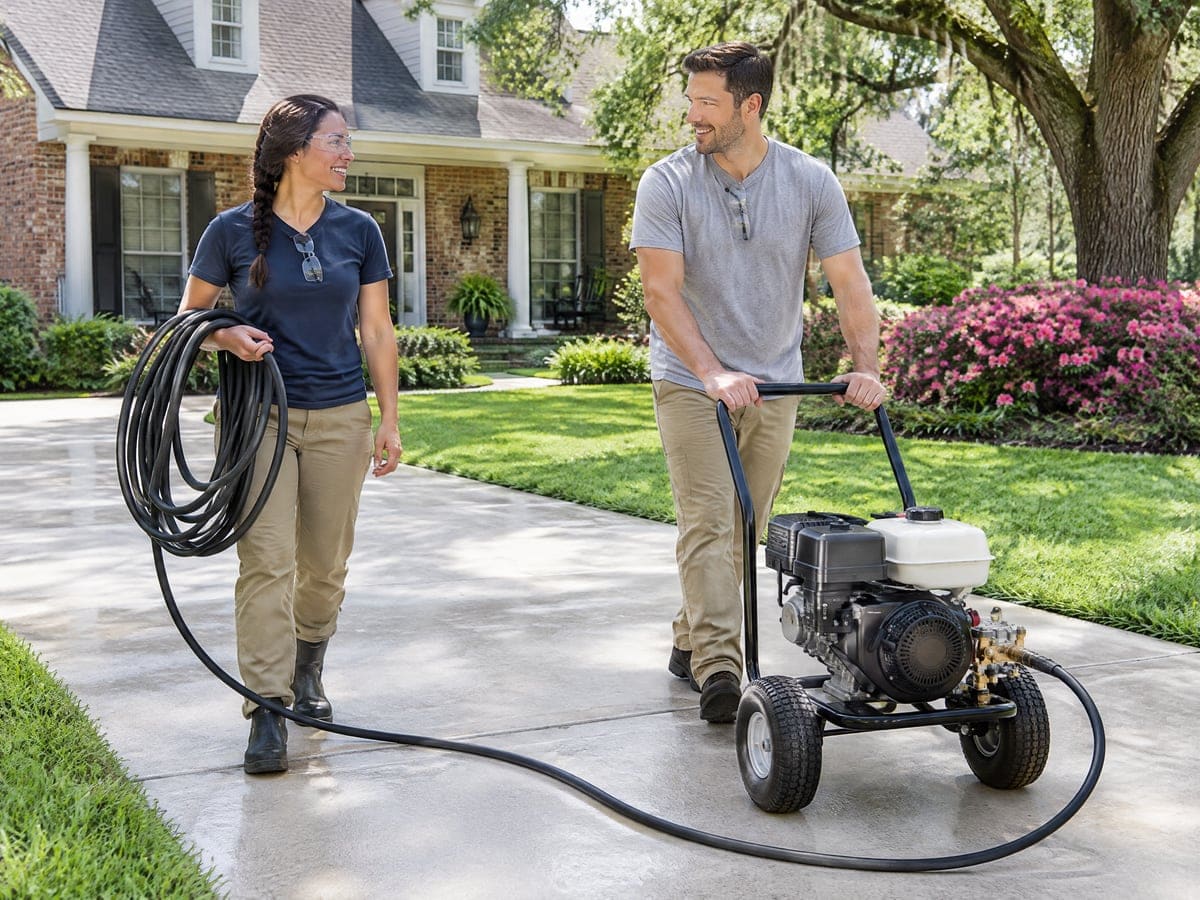
What a wash on a Baton Rouge home covers
Outside only, surface by surface: siding and the trim around it, brick and painted wood, stucco walls, shingle and tile roofs, driveways and walks, patios and pool decks, wood decks and privacy fences, vinyl rail and the outside faces of the gutters.
Related pages:
How a call goes
Phone (225) 635-8356 and sketch the house. The surfaces on your list, what each is made of, how much of the roof shows up from the yard, and which plants and pets will be around.
A property manager or a landlord has a few more items on that call: a side gate code, whoever is at the place during the day, and who signs off on the price. A homeowner with a listing or an open house on the schedule brings the dates.
The house gets looked at before any work, and nothing starts until you agree.
Where the price moves
Pricing moves on these pieces of a job:
| Driver | What shifts |
|---|---|
| The surfaces | How many on the list, from siding to the drive |
| The materials | Vinyl, fiber cement, painted wood, stucco, brick, shingle, concrete, pavers, wood or vinyl rail |
| Reach from the ground | One story or two, where the gutters sit |
| Growth and staining | Green film, dark streaks, oil, rust |
What goes into a pressure washing price covers each one in detail.
Baton Rouge storm drain guidance
Water that enters a Baton Rouge storm drain is not treated at a wastewater plant; it flows straight to streams, rivers and lakes without treatment.1 The City-Parish asks residents to clear debris with a broom instead of a hose, because hosing pushes debris into storm drains.2
Baton Rouge houses
Baton Rouge is a city of houses. Single-family detached houses make up 58,401 of 106,712 housing units, about 55 percent.3 The median home was built in 1976.4
A warm, humid year
Baton Rouge's climate is a long warm humid stretch. The city's airport averages 61.94 inches of rain a year under the 1991 to 2020 normals.5 The average relative humidity runs 89 percent in the morning and 59 percent in the afternoon over the year; August mornings average 93 percent.6
Spanish moss shows up on fences too, not only on live oaks. Spanish moss is not a parasite and does not feed on trees; it grows on live oaks and bald cypress, and also on dead trees, fences and power lines.7 Lichens are a fungus paired with algae or cyanobacteria that attach to trees, shrubs, rocks, walls and fences8 and do not harm what they grow on. Several hundred lichen species have been identified in Louisiana,9 and since they make their own food they can grow on fence posts, metal railings and other surfaces beyond trees.