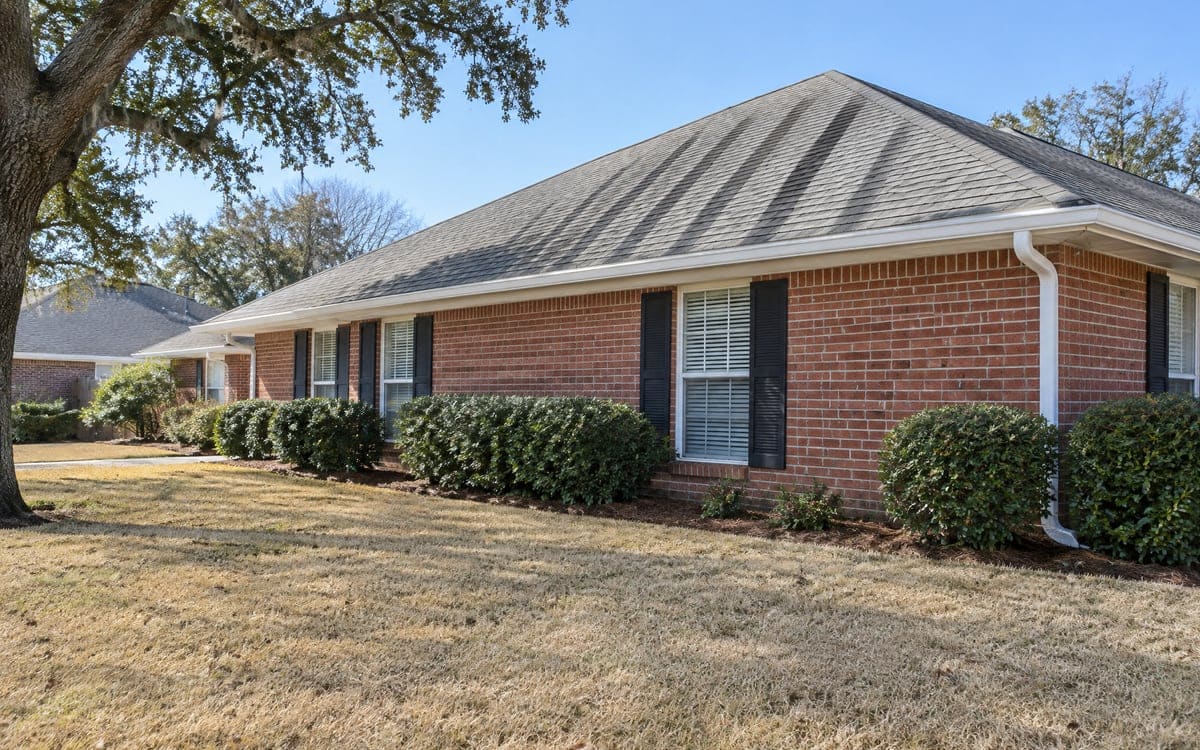
The streaks are algae
If you have been staring at the north side of your roof wondering what the gray-black lines are, the Asphalt Roofing Manufacturers Association says the black discoloration and streaks visible on many roofs across the United States and Canada are actually algae, most often one called Gloeocapsa magma. The dark color comes from a sheath the algae produces to protect itself from ultraviolet rays.
Algae is a living growth on the surface, not a stain in the finish. It sits on the shingles and spreads where the conditions suit it.
Humid weather suits it
Humid climates suit algae, and Baton Rouge sits in exactly that kind of climate. Over the year, the city's average relative humidity is 89 percent in the morning and 59 percent in the afternoon, and August mornings average 93 percent.
Streaks turn up roof after roof on a Baton Rouge street
If one neighbor's roof is streaked, it is common to see the same lines on the house next door. Roof algae spores travel on wind and animals, which is why streaks often show up on roof after roof in the same neighborhood; by the time it shows, it has likely been there for months. One block of streaked roofs is a common sight rather than a one-off problem for a single house.
Algae and moss are different problems
Streaks and moss are often lumped together in conversation, but they are not the same thing on a roof.
Roof algae and moss are different problems
The black streaks mostly affect how a roof looks. Moss favors the shady slopes and can lift shingle edges.
Black streaks
Roofing makers say they are algae.
- Often mistaken for mold or mildew.
- Humid climates suit it most.
- No scientific evidence that it damages asphalt shingles.
Moss
Grows where the roof stays damp.
- Tends to grow on north-facing slopes and under branches that keep a roof shaded.
- Can lift or curl shingle edges, which raises the risk of blow-off in wind.
There is no scientific evidence that algae damages asphalt shingles, but moss can lift shingle edges and raise the risk of blow-off in wind. Algae is a cosmetic concern on asphalt roofs. Moss is a different conversation because it has thickness and holds water in a way the flat film of algae does not.
If you are not sure which you are looking at, it is a reasonable thing to point out when you call. Streaks that trail down from a ridge are usually algae. Patches that look fluffy or three-dimensional on the shingle are usually moss.
| What you see | What roofing makers say it is | What washing does |
|---|---|---|
| Dark streaks running down the slope | Algae (Gloeocapsa magma), a cosmetic concern | Cleans the stain off the shingle |
| Fluffy green patches on the shingle | Moss, which can lift shingle edges | Cleans the moss off; a roofer handles any lifted shingles |
| Dark streaks that start at a ridge | Algae spread from one rooftop to another on wind and animals | Cleans the stain off the shingle |
| Green film on a north-facing slope under trees | Moss on a slope that gets less sun and stays damp longer | Cleans the slope at low pressure from the ground |
| Streaks on one slope but not the other | Humid climates suit algae; the shady slope holds moisture longer | Both slopes get washed if both have anything on them |
The shady side holds moisture longest
Moss tends to grow on north-facing roof slopes that get less sun and stay damp longer, and overhanging branches add shade and debris that hold moisture. The streaks on the front of a house, by comparison, often start as faint lines on the gable or dormer and spread downward.
The sun side of the roof usually looks cleaner than the shady side. On any one house, the slopes under the heaviest shade are usually where the streaks or green patches show up first. On the day of the wash, the crew usually starts on the shadiest slope and comes around to the sunny side after, because the shade side wants the most careful look and the sun side tends to lift with less effort. Each slope gets its own pass rather than one long run around the house.
On a Baton Rouge block of mature live oaks, the slope that sits under a canopy for most of the afternoon tends to catch and hold moisture. A sun-only slope with no tree cover usually looks closest to the shingles' original color. On a dormer, the small plane facing north may darken while the plane facing south on the same dormer stays clean, which is a useful thing to notice from the yard when deciding what to call about.
A roof gets washed at low pressure, from the ground
The method a wash uses on a roof is not the method a wash uses on a driveway. Roof cleaning is done at low pressure. The roof is washed from the ground, so no one is standing on the shingles and nothing on the roof itself is being walked over. A homeowner's check of the roof happens from the yard, not from a ladder.
A low-pressure rinse from the ground travels across the shingles the way a steady rain would, lifts what has settled on them, and runs down into the gutter. The plants against the house are watered first and the beds below the eaves get checked for anything that would do better out of the way. The gutter fronts and the top of the siding right under the eave get a rinse on the same pass, so the walls below the roof come out looking even rather than streaked by what came off the shingles.
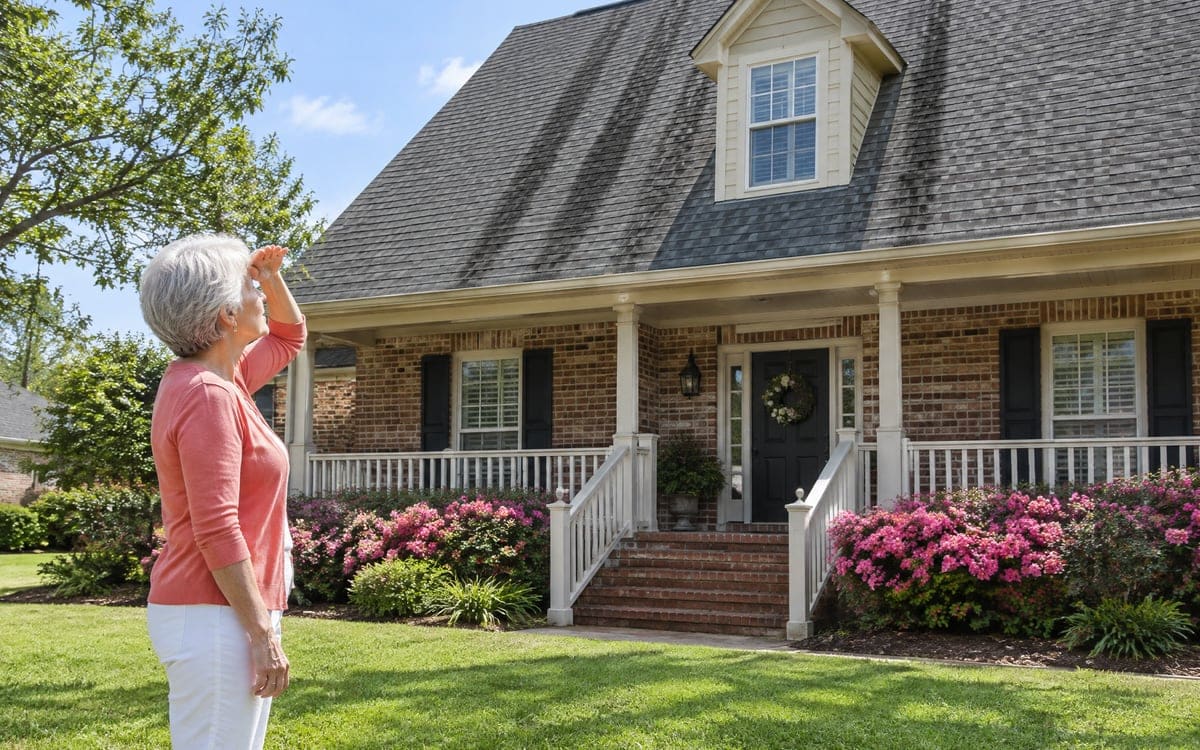
Stand in the yard, step back far enough to see the whole slope, and look at what the pattern is doing. Where are the lines starting? Which planes have them worst? Where is the shade heaviest? Those answers are easier to see from the ground than from a ladder, and they tell a crew what to expect before anyone gets to the house.
What you see on your own slope is often part of a wider pattern on the block, which is why standing in the yard and glancing at the roofs across the street is useful too.
What roof cleaning does not do
A wash cleans the shingles. Anything wrong with the shingles themselves, cracked, lifted or missing, is a roofer's work rather than more water. The wash can make a bad shingle easier to spot once the dark stains come off, but the fix stays with the roofing trade.
If a wash makes something clear that a roofer should look at, we tell you plainly and leave the next step to you.
The shingle maker's paperwork comes first
Before any roof cleaning, it is worth looking at who made your shingles and what their cleaning instructions say. Shingle makers each have their own guidance on cleaning methods, and that paperwork is theirs, not ours. If your shingles came with manufacturer paperwork and it is in a drawer, it is a good moment to read the cleaning section before scheduling a wash. A specific maker may spell out an approach, and that document wins; we wash the roof at low pressure regardless.
If you cannot find the paperwork, the roofer who installed the roof usually knows what shingles are up there and can point you to the right manufacturer's site.
Shade and gutters
Roofing makers say trimming tree branches back to let more sun reach the roof and keeping gutters clean makes a roof less inviting to algae and moss. Tree trimming is tree work and belongs to a tree company; we do not do it. Roofing makers also note that algae-resistant shingles with copper granules are one option at replacement time, and that algae cuts into how well reflective "cool" roofs work over the years.
While the roof is cleaned, the walls below often come up in the conversation. Washing the walls below is usually soft or pressure decided by the surface, and both can be part of the same job. If you want a sense of how the roof shows up on your quote compared with the walls, what moves the price of a wash walks through that side.