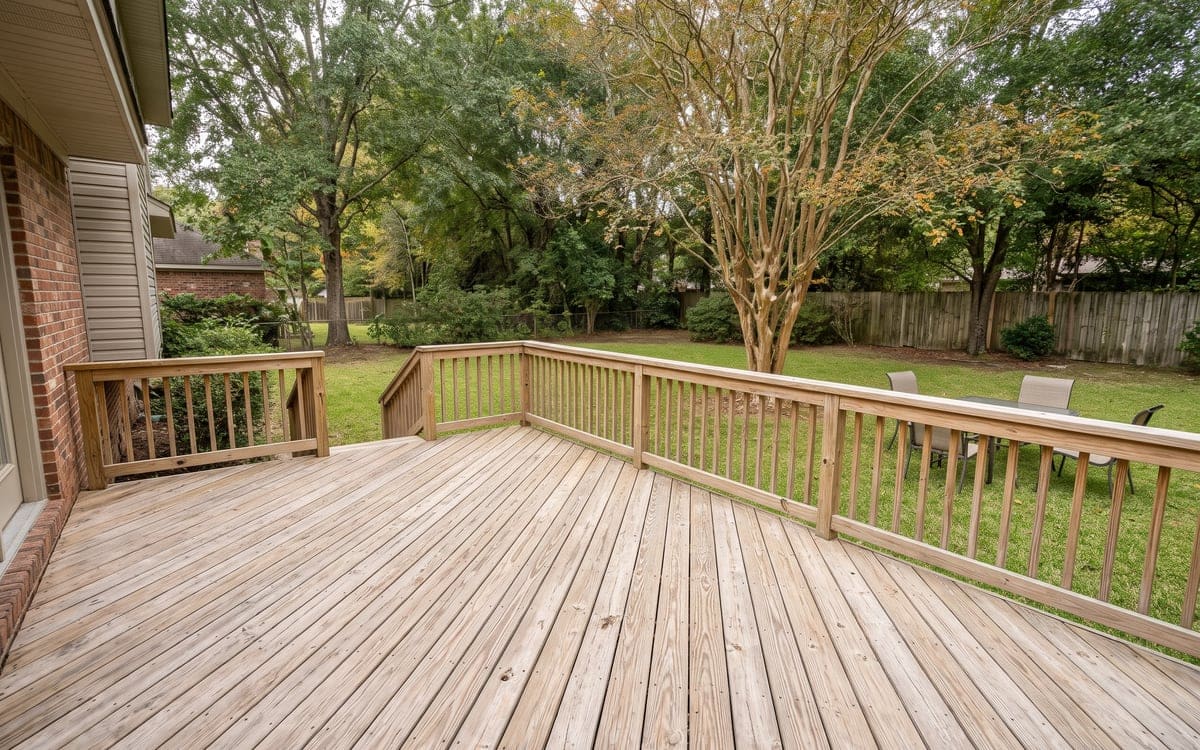
Stain binds to clean wood
The grain on a deck board has peaks and valleys. Over time, the valleys fill with dust, pollen, bits of leaf, mildew film and weathered wood fiber that lifts up when the board sits in weather. Stain poured over that layer binds with the layer, not with the wood below it. Boards washed first before stain tend to wear more evenly than boards that were not.
Deck cleaning before a stain job is less about the deck looking right this weekend and more about giving the stain something to grip.
The wash follows the grain
Direction matters on wood. Every pass goes the long way of the board, along the grain, with the wand far enough off the surface that the water does the work rather than cutting into the top of the fibers.
A deck is a stack of boards with gaps rather than one slab, so each board gets its own pass.
Too much pressure raises the grain
A tight stream held too close to a board lifts fibers out of the top of the wood. Once the wood dries, those fibers stand up and the surface feels fuzzy under a hand. The sun bleaches those fibers next, which is why a deck that was washed too hard often looks lighter and fuzzier. Stain over a furred board takes unevenly and shows wear patterns.
A smooth board is the sign the wash was in the right range. If a board feels furred, the next step is a light sanding before stain goes on. Whoever is going to stain the deck decides whether a sanding is needed.
The wood dries before stain
Stain on wet wood sits on top in a thin film that often flakes along the grain. A wash the morning of a stain is a wash in the wrong order. The wash goes first; the stain goes on once the boards have dried out enough for the wood to take it.
The dry condition matters more than the clock. Check the gaps between the boards and the underside of a board you can reach, and whoever is going to stain the deck decides whether a moisture meter reading is needed.
October afternoons are Baton Rouge's least humid, averaging 54 percent relative humidity.1 Across the year, the airport sees about 114 days with measurable rain and about 19 days with an inch or more.2
Staining is a separate job
The stain product, the sanding plan, the application and the finish coat all sit with whoever stains the deck. A wash company handles the wash. The stain is the stainer's.
That matters on a deck that has old stain already on it. Old stain lifting in sheets or peeling along the grain is not something a wash alone clears. A stainer may want to strip the old finish first, which uses a different product than a cleaning wash. On a deck where the old stain is weathered thin, a wash often clears enough of the film to let a new stain soak into the lighter wood, but that is the stainer's call.
The shape of a wash on a deck, by what the boards look like going in:
| Deck condition going in | What the wash does |
|---|---|
| Even gray weathered boards | Clean the top layer off |
| Patchy stain, wearing thin | Lift the dirt and some of the film |
| Peeling stain in sheets | Clean around it |
| Soft or rotten boards | Clean around them |
| Furred boards from a prior bad wash | Clean again gently |
Fences and composite
A wood fence follows the same logic as a deck. A wash before a stain or seal on a fence gets the pickets ready the same way. Grain direction and pressure range are the same. Pickets are often smaller and more weathered, so the wash plan is lighter.
Composite boards are a different conversation. Composite is not meant to be stained the way wood is, and the wash on composite follows the maker's instructions rather than the wood playbook. Cleaning composite is part of what a wash can do; sealing or re-staining composite is not a service we offer.